
Final sale meaning is simple: the seller will not take the item back for a refund, exchange or store credit once you buy it. Stores use the label for clearance stock, custom orders and goods they cannot resell.
The label has limits. It stops change-of-mind returns but leaves a shopper’s rights for faulty or wrongly described goods. In the EU it also leaves the 14 day right of withdrawal in place for most goods.
We read the EU consumer portal, Ireland’s consumer regulator and a retailer’s published policy in November 2026. We tested the WooCommerce setup on WPReturns Pro 1.0.0, our own plugin. This guide covers the meaning, the limits, the setup steps, a policy template and wording that keeps trust.
Final Sale Meaning in Retail
In retail the final sale meaning is a purchase the seller will not refund, exchange or take back for a change of mind. The seller states this before checkout. Levi’s lists clearance, limited-edition and customized items as final sale, without returns, refunds, exchanges or price adjustments (Levi’s Help).
Final sale is a seller’s term and not a legal status. It only means what the store’s policy says. Read that policy before you pay.
Final sale also differs from a clearance price. Clearance is a price while final sale is a rule about what happens after you pay. A store can discount an item and still accept returns.
Stores usually mark these kinds of goods:
- Clearance and end-of-season stock that was marked down to clear shelves.
- Custom, engraved or made-to-order items that nobody else can buy.
- Limited-edition drops with no restock.
- Goods that cannot be resold once opened.
Levi’s says final sale items are marked throughout the shopping experience. That is the standard to copy. A buyer should see the label on the product page and again at checkout.
What Does All Sales Final Mean?
All sales final means the store applies the final sale rule to every item, with no returns, refunds or exchanges once you pay. It is the store-wide version of a final sale label. The same limits apply: faulty goods and statutory rights stay outside it.
Buyers read it as a risk. Many stores limit the label to chosen items and keep a normal return window for the rest.
“All sales are final” and “no refund” are not the same sentence. Final sale blocks returns for a change of mind.
A blanket no-refund notice can be read as covering faults too. That reading may not hold up where consumer law protects buyers.
Can You Return Final Sale Items?
Usually not for a change of mind, but you can still ask for a remedy when an item is faulty or not as described. EU online buyers also keep a 14 day cooling-off period for most goods. Check the exceptions list before you assume an item is exempt.
Here is how to return final sale items when you have a valid claim:
- Check the item is not faulty or different from its listing. A fault or a wrong description is a different claim from a change of mind.
- Read the seller’s policy for the exact wording. Some sellers keep a short window for defects.
- Contact the seller in writing and describe the problem with photos.
- If you bought online in the EU, check whether the 14 day cooling-off period applies to that item.
Shoppers on a WPReturns store see this at once. Items that cannot be picked on the return form appear grayed out with the reason, such as final sale.
Are Final Sale Policies Legal?
A shop can usually refuse change-of-mind returns, but online sales in the EU follow different rules. Ireland’s regulator says faulty goods bought in a sale carry the same rights as full-price goods. Rules differ by country and you should check the ones that apply to your buyers.
The EU consumer portal says online buyers have a 14 day cooling-off period that a final sale label does not switch off. The portal lists the exceptions. They include goods made to order or personalized, perishable goods with a short use-by date and sealed audio, video or software once unsealed (Your Europe).
Ireland’s Competition and Consumer Protection Commission explains the shop side. In-person buyers are not automatically entitled to a refund after a change of mind, and each business sets its own policy (CCPC). A sale does not change the rights for faulty goods.
The EU portal also says the trader pays to return a defective product. That cost stays with you even on a final sale item.
US rules differ by state and this guide does not cover them. Check your state’s rules on posted refund policies before you publish one.
When Should a Store Use Final Sale?
Use final sale where a return costs you the item, such as custom goods, hygiene goods and deep clearance. Skip it for stock with known quality issues. Rank your catalog by how often a returned unit can be resold and mark the lowest first.
Use these cases in this order:
- Custom and personalized items. Nobody else can buy them, and they are on the EU exceptions list.
- Hygiene or sealed goods that cannot go back on the shelf once opened.
- Last-chance clearance with a clear markdown and no restock.
- Limited editions that sell out and never return.
Keep a normal window for everything else. A store that marks only chosen items stays easy to buy from. Our return rules feature page lists the other ways to limit returns without a blanket rule.
A final sale label also does not replace a clear fee policy. Our guide to the restocking fee covers the middle path for items you can resell.
Final Sale vs Store Credit Only vs a Standard Return
Final sale blocks refunds, exchanges and credit for a change of mind. Store credit only blocks the cash refund but keeps the money in your store. A standard return gives the refund back after the item arrives and passes your checks.
| Policy | Refund | Exchange | Store credit | Best for |
|---|---|---|---|---|
| Final sale | No | No | No | Custom goods, hygiene goods and deep clearance |
| Store credit only | No | Yes | Yes | Sale items you can resell |
| Standard return | Yes | Yes | Yes | The rest of the catalog |
Each row trades margin for goodwill. Pick the row per product and not per store. Our guide to store credit and refunds shows when credit is the better middle path.
How to Set Up Final Sale in WooCommerce
WooCommerce has no built-in returns system and no final sale setting. WPReturns adds one in two places: a Final-sale categories field on its Return Policy tab and a Final sale box on each product. Both are in the free plugin.
How a final sale item moves through your store
- 01Mark itCategory or single productStep 1 and 2
- 02Show itNotice on the product page and at checkoutStep 3
- 03Block itGrayed out on the return formResult
- 04Keep the lawEU withdrawal and warranty stay openStep 4
Step 1: Mark a Final-Sale Category
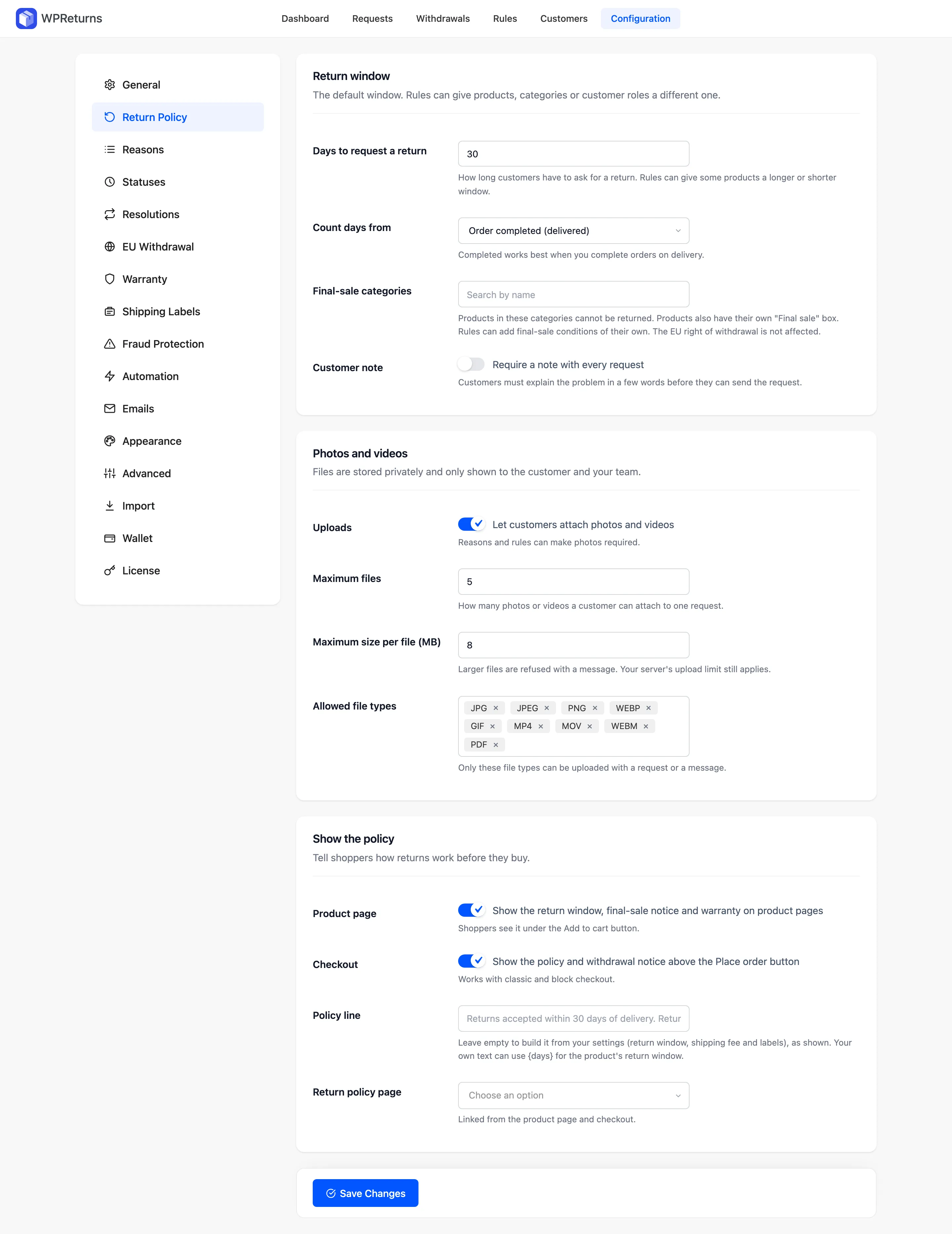
Go to DevDiggers Plugins > WPReturns > Configuration > Return Policy. Pick one or more categories in Final-sale categories and select Save Changes. Every product in those categories cannot be returned.
Use this for a clearance category that you refill each season. New products you add to it become final sale at once.
1WPReturns > Configuration > Return Policy
Step 2: Mark a Single Product
Open the product and tick the Final sale box on the General tab of the product data panel. Customers cannot request a return or exchange for that product. Warranty claims and the EU right of withdrawal are not affected.
Use the box for a one-off item such as a custom print. The free plugin handles both the box and the categories.
2Product page
Step 3: Show the Notice Before Checkout
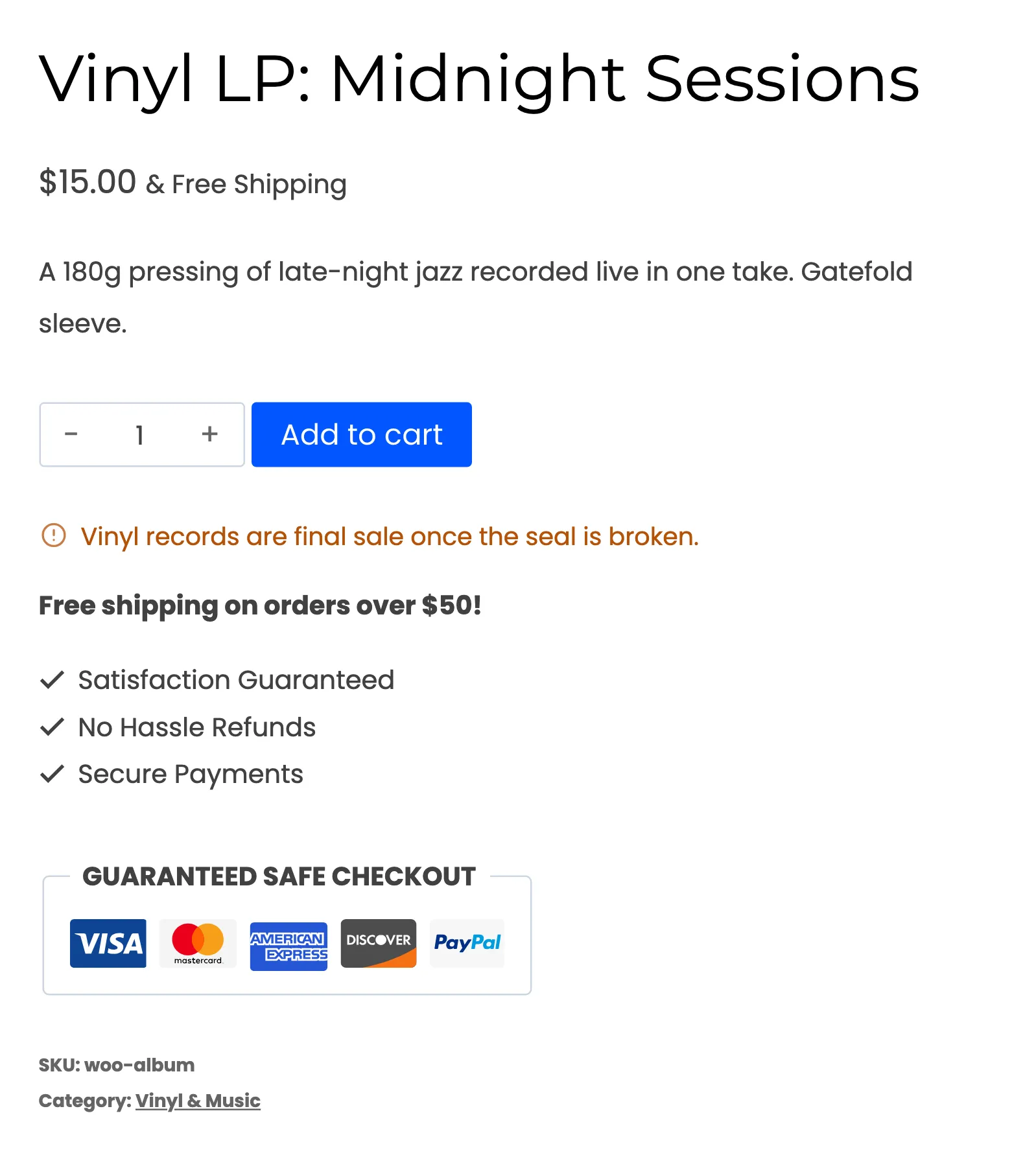
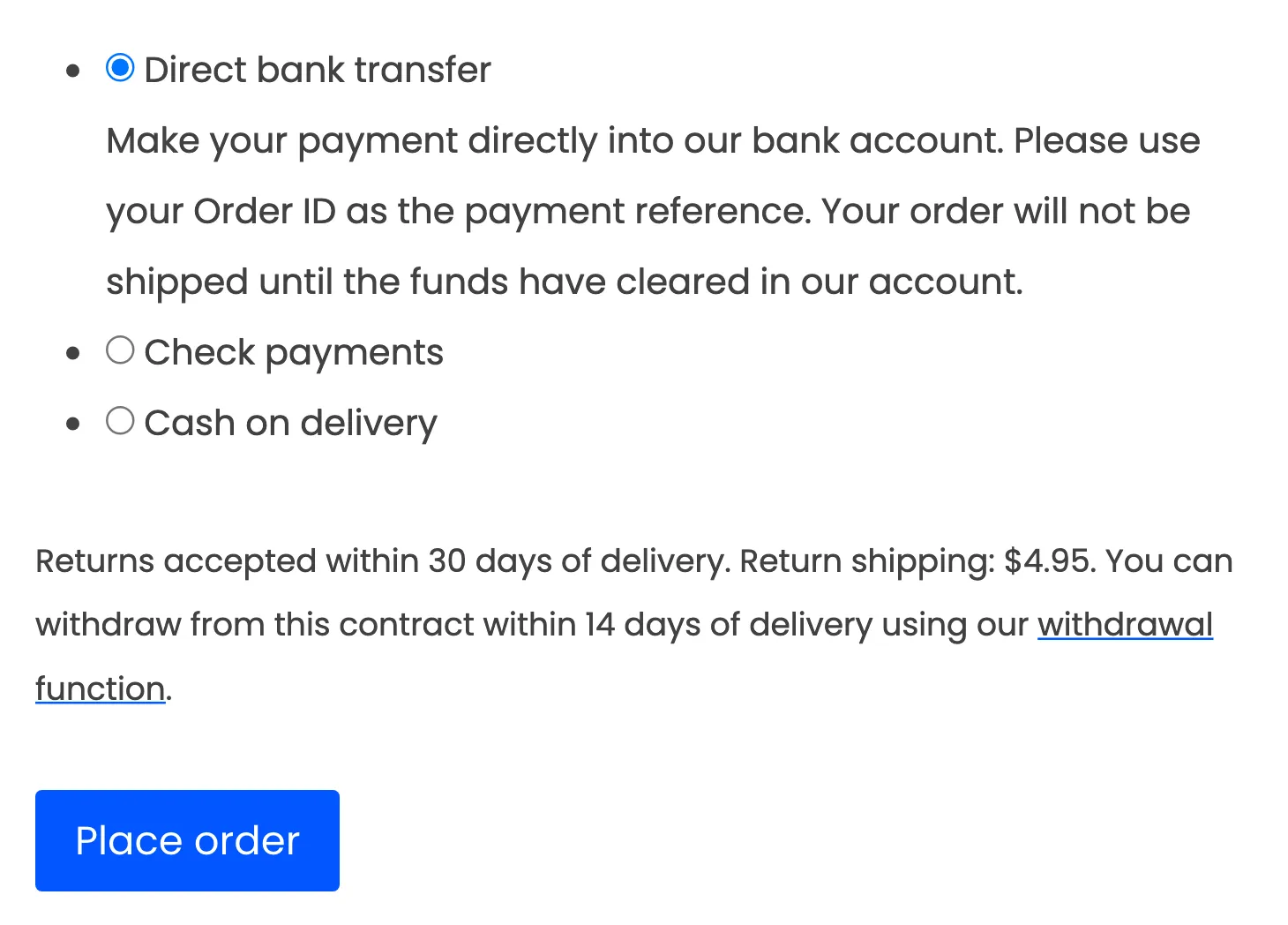
Keep Product page and Checkout switched on under Show the policy on the same Return Policy tab. Shoppers then see the terms under Add to cart and above Place order. Classic and block checkout both show the line.
Leave the Policy line empty and WPReturns builds it from your settings. Add a Return policy page and the line ends with a Details link to it. See the return policy settings guide for every field.
3Checkout
Step 4: Keep EU Withdrawal Honest
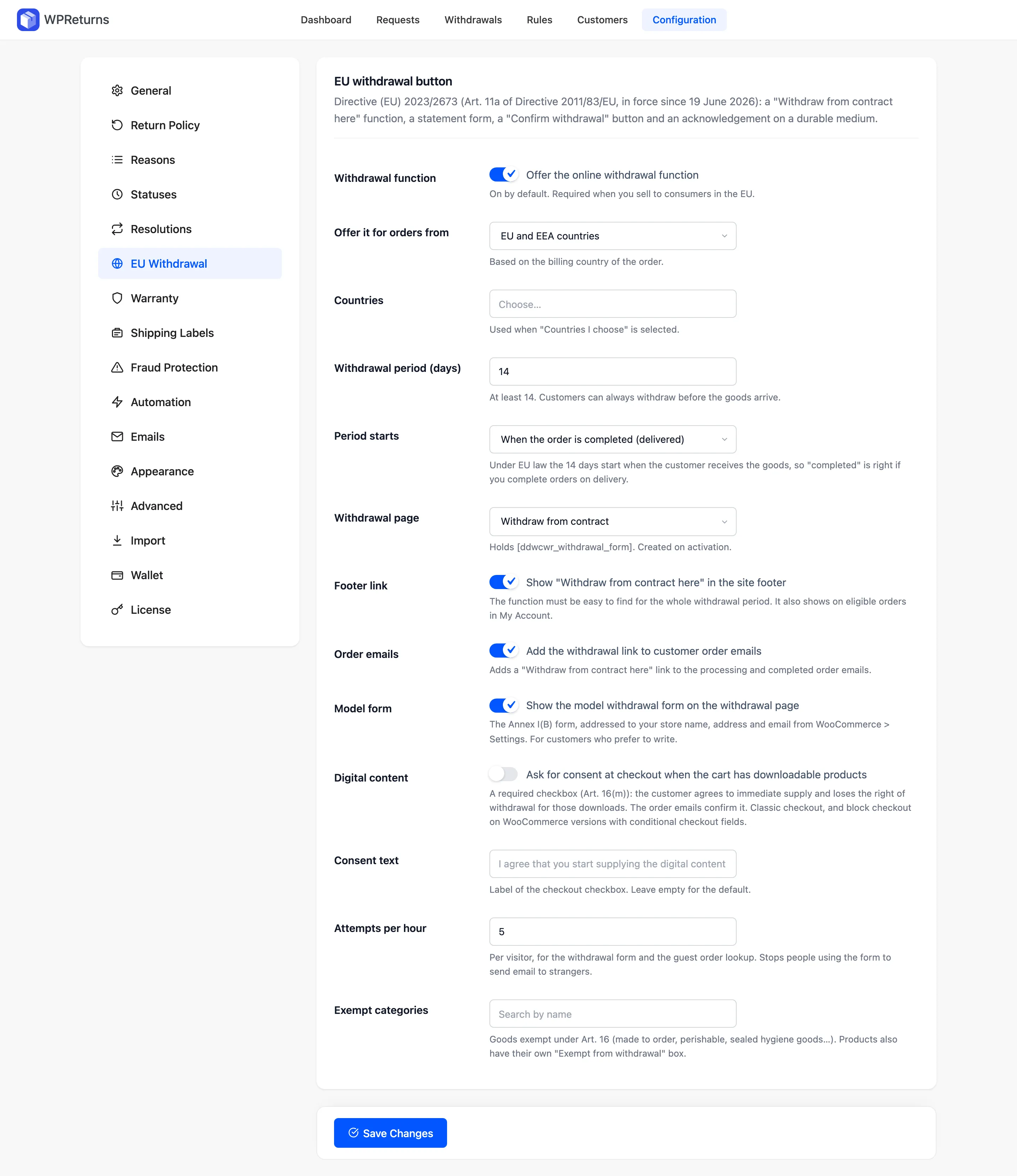
Final sale on the Return Policy tab only stops returns under your own policy. A final-sale item can still be withdrawn from unless it is also exempt. Mark exempt goods on DevDiggers Plugins > WPReturns > Configuration > EU Withdrawal.
Pick whole categories in Exempt categories or tick Exempt from withdrawal on one product. Only mark what the law lists, such as made-to-order goods. Read our EU withdrawal button guide before you do.
4WPReturns > Configuration > EU Withdrawal
Step 5: Add a Rule for Price or Customer (Pro)
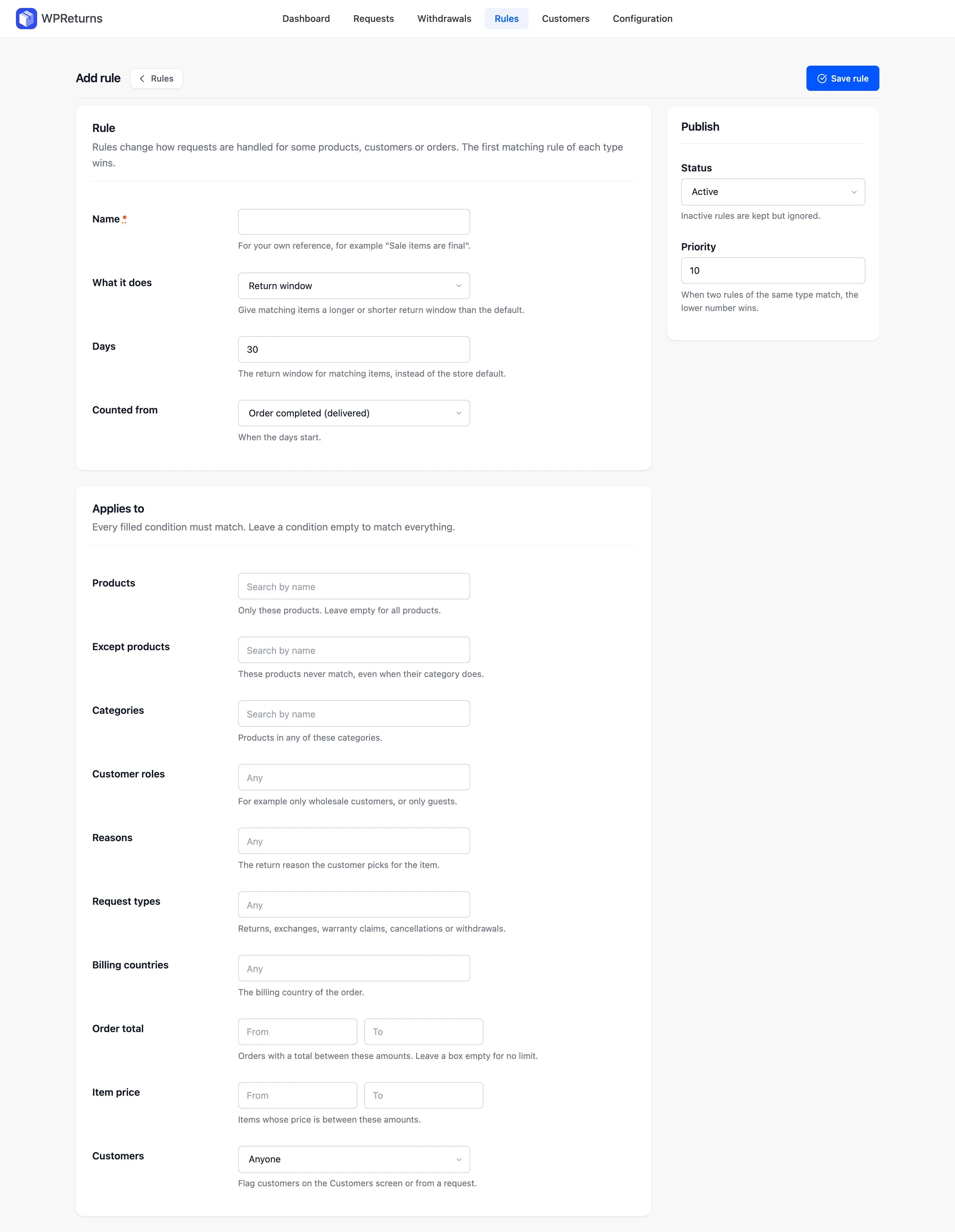
Go to DevDiggers Plugins > WPReturns > Rules and select Add New. Set What it does to Non-returnable items and choose what it applies to. Rules can mark an item final sale by item price, order total or customer.
The rule has a Message to the customer field that replaces the standard text on the product page and the grayed-out return form. This step needs WPReturns Pro, and the free and Pro page shows the split.
5WPReturns > Rules > Add rule
How to Write a Final Sale Policy
A final sale policy needs four short parts. Name the items it covers, say what it blocks, state what stays open and give a contact for faults. Put the full text on a policy page and repeat one line at checkout where shoppers decide.
Copy this template and replace the details:
Final sale items are marked "Final sale" on the product page and at checkout.Final sale items cannot be returned or exchanged for a change of mind.If an item arrives faulty or not as described, contact us within 14 days of delivery with photos and we will make it right.Customers in the EU keep their statutory right of withdrawal unless the item is made to order or personalized.Keep the 14 days in the faults line the same as the number you promise elsewhere. Link the policy from the footer, the product page and checkout. Add the same text to your order emails so the rule is on record.
Our return and refund policy template holds a full version with a section for each case.
How to Sell Final Sale Items Without Losing Trust
Say it early and plainly by putting the final sale label next to the price, repeating it at checkout and naming what stays open. Shoppers accept a clear rule they see before paying. They resent one they find only after paying, and that is where disputes start.
Four habits keep trust:
- Mark the item where the price sits and not only in the footer.
- Describe fit and condition in detail. A buyer cannot return a guess.
- Offer help before the sale through a contact link on the product page.
- Treat a fault claim on a final sale item as a normal claim and answer it fast.
A clear final sale label also helps you if a payment is disputed. Our guide to chargebacks and refunds explains what evidence a card network asks for.
Conclusion
Final sale meaning comes down to one rule: no returns for a change of mind. It does not remove rights for faulty goods, and in the EU it leaves the 14 day right of withdrawal in place for most items.
Use the label on custom, hygiene and clearance goods. Show it before checkout, state what stays open and keep the EU exemptions limited to what the law lists. The free WPReturns plugin handles the marking and the notice, and WPReturns pricing adds rules by price, order total or customer.